
Pro Plumbers · 27 November 2026
Why is my unvented cylinder tundish dripping?
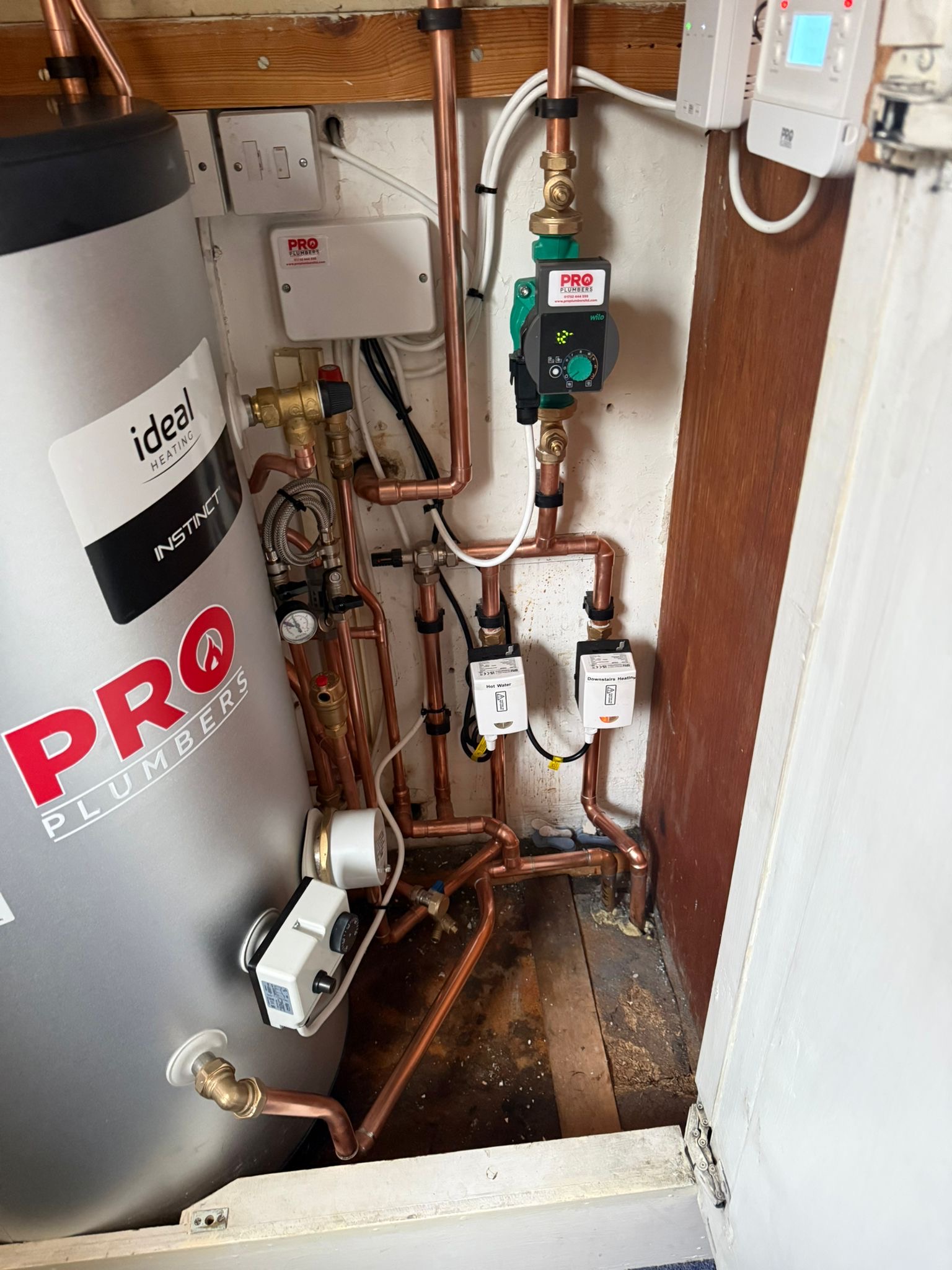
A tundish is a visible fitting in the safety discharge arrangement of an unvented hot water cylinder. Water passing through it provides a warning that deserves attention. A few drops do not identify the failed component, and a dry floor beneath the cylinder does not mean that everything is operating correctly.
Keep clear of escaping water because it may be hot. Never block the tundish, cap its outlet or operate the connected safety valves to try to stop the drip. Investigation and work on an unvented cylinder should be carried out by a G3-qualified engineer.
Recognise the visible air gap without dismantling it
A tundish usually provides a visible air gap between parts of the discharge route, allowing water release to be noticed. Its appearance varies, and nearby condensate or drain fittings can cause confusion. Look at the cylinder documentation or take a photograph from a safe position rather than undoing a connection to establish what it serves.
The unvented cylinder guide explains the wider system. If you are uncertain whether the cylinder is unvented, say so when requesting help. Do not assume a nearby valve or pipe is safe to operate just because it resembles an ordinary plumbing fitting elsewhere in the property.
Timing can help distinguish different discharge patterns
Note whether water appears only during normal cylinder heating, continues between heating periods or has recently become more frequent. Record a pattern during ordinary observation rather than starting extra heating cycles to provoke a drip. A brief video taken without approaching hot pipework can be more useful than describing the amount as small or large.
Discharge during heating can be associated with expansion arrangements, while other patterns may lead the engineer towards inlet controls or a relief device. These are possibilities, not household diagnostic rules. The same visible symptom can arise for different reasons, and more than one issue may be present. Keep the original operating settings unchanged while gathering information.
Heated water needs somewhere to expand safely
Water expands as it heats, and an unvented system must accommodate that change using the arrangement specified for the cylinder. Depending on the design, this can involve an expansion vessel or an internal provision. If that arrangement is not working as intended, a safety valve may release water rather than the system simply absorbing the expansion.
Do not try a generic vessel recharge or air-gap procedure from another cylinder's instructions. Product designs differ, and a discharge fault needs proper assessment before any maintenance action. A G3-qualified engineer can identify the intended arrangement and investigate it safely. The hot water cylinder service information is the relevant starting point for this type of enquiry.
Incoming water controls can also affect the symptoms
The cylinder's inlet control arrangement helps provide suitable supply conditions. A fault or contamination affecting those components can contribute to discharge, but a drip does not tell you which part needs attention. Guessing from the sound of filling water or the feel of a tap can lead to replacement of the wrong component.
Leave the inlet controls intact. Do not adjust unfamiliar screws, bypass a valve or fit an improvised part to suppress the symptom. Tell the engineer about recent plumbing work, supply interruptions or changes in tap behaviour. That history can help guide testing without turning it into an assumption that the public water supply is necessarily at fault.
A relief valve may need checking as part of the cause
A valve that has released water may not close correctly afterwards, for example if its sealing surfaces are affected. That does not mean replacing the valve alone will resolve the reason it opened. The engineer needs to consider both the current leakage and the conditions that led to it, including expansion and temperature control where relevant.
Do not lift or twist a safety valve lever in an attempt to wash a fault away. Operating it can release hot water and may not restore a sound seal. Avoid touching the pipe to identify which valve is passing. Give the G3-qualified engineer the observed pattern and allow them to carry out the checks required by the specific cylinder design.
Overheating signs require a more urgent response
Very hot tap water, steam, forceful discharge or unusual boiling noises are not symptoms to monitor casually. Keep everyone away from the cylinder and discharge route. Stop the hot water heat sources using normal accessible controls if it is safe, and seek urgent professional advice. Do not approach wet controls or open an enclosure to find a switch.
A cylinder may have more than one heat source, so make clear what you know has been switched off and what is uncertain. Stored heat remains after heating stops. Unvented cylinder work requires a G3-qualified engineer; any work on a connected gas boiler requires a Gas Safe registered engineer. Do not use a relief valve to try to cool the stored water yourself.
Keep the full discharge route open and visible
The tundish is only one part of a route intended to carry released water away safely. The downstream pipe and termination matter too. A blocked or altered route can undermine that function even if the visible fitting looks tidy. Never fit a cap, reduce the outlet or hide the fitting behind permanent storage to stop seeing the drip.
Do not connect a hose to divert discharge into a bucket or move pipework to keep a wall dry. If the route is leaking, overflowing or appears damaged, explain that when arranging help and avoid the area. Protect belongings only where it is safe and without touching pipework. Discharge should not be treated as a routine source of water for another use.
Arrange a cylinder-specific assessment with clear observations
Record the make and model from accessible labels, the heating schedule and whether discharge coincides with heating. Mention recent servicing or changes to hot water performance. If an immersion source seems involved, the immersion heater guide provides background, not instructions to open or repair components.
For broader system concerns, see heating engineer information, then request an unvented cylinder assessment and explicitly mention the dripping tundish and the need for G3 competence. Highlight any overheating or forceful discharge rather than describing it as an ordinary leak. Do not wait for a routine appointment if the current conditions appear unsafe.