
Pro Plumbers · 26 November 2026
Why is my hot water cylinder leaking?
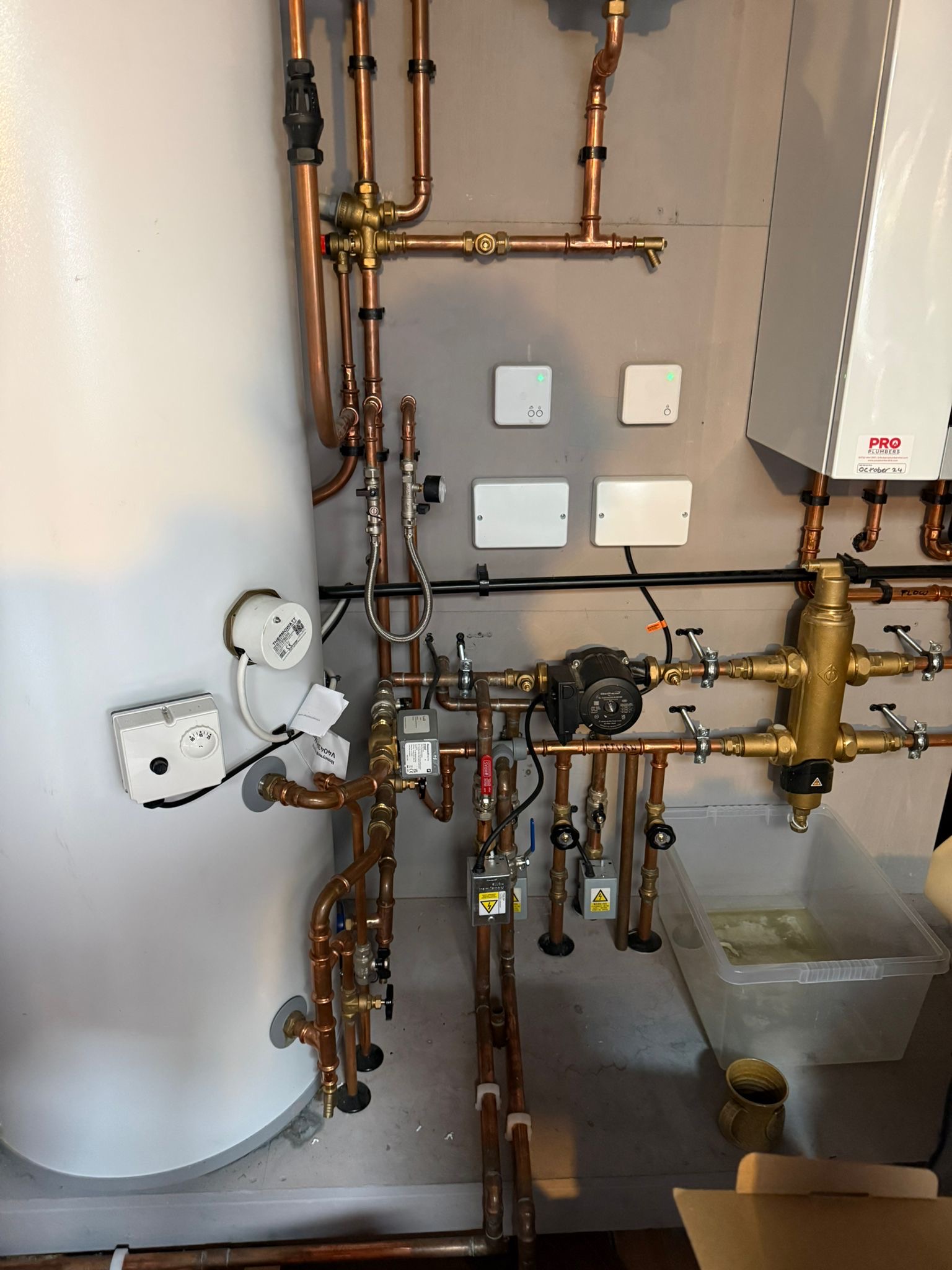
Water around a hot water cylinder should not be dismissed as ordinary condensation. It may come from a connection, a valve, the cylinder itself or pipework nearby. On an unvented system, water from the safety discharge arrangement has its own meaning and should never be blocked or redirected casually.
Do not remove panels, tighten valves or touch wet electrical controls. Identify what you can see safely, stop avoidable hot water demand and arrange the right professional help.
Locate the visible water without moving the cylinder
Use a light from a dry position to see whether moisture begins high on the pipework, around a connection, beneath the cylinder or on a nearby surface. Take photographs before wiping accessible areas. Water can run down the outside and drip far below its source.
Do not pull the cylinder forward or loosen insulation to improve the view. Keep stored items away if they can be moved without approaching water or electrics. If the ceiling below is stained or sagging, keep clear and explain that when calling.
Know whether your cylinder is vented or unvented
A vented cylinder is normally associated with a separate cold-water storage arrangement, while an unvented cylinder is fed from the mains and has specific safety controls. Installation documents and visible labels are better evidence than guessing from the cylinder's colour or age.
Our unvented cylinder guide explains the safety devices and why a G3-qualified installer is required. If you cannot identify the system, say so when calling rather than operating valves experimentally.
Water from a discharge pipe is not a routine drip
Unvented cylinders have a discharge arrangement designed to relieve unsafe conditions. Water appearing during operation can indicate that attention is needed, especially if it continues or changes from the system's documented behaviour. The visible tundish and outlet should remain unobstructed.
Never cap the pipe, block the outlet or tighten a safety valve to stop it. Do not touch hot discharge water. A G3-qualified installer should investigate the cause and test the relevant controls rather than treating the visible drip as an isolated plumbing nuisance.
Connections and valves need proper identification
A damp union, control valve or immersion heater boss may look similar from a distance, but the repair and isolation procedure differ. Do not tighten the nearest nut because it appears wet. Movement can worsen a joint or disturb adjacent components.
If the cylinder has an immersion heater, water near its electrical connection is a reason to keep clear. Do not switch anything at a wet control. Our immersion heater guide gives separate owner-check boundaries, but active leakage requires professional advice first.
Turn off heat demand where it is safe to do so
Use the normal hot water programmer or appliance control to stop further heating if you can do so from a dry position. This does not make the cylinder safe to dismantle, and stored water can remain hot. Do not open a drain valve to empty it.
Gas boiler work requires a Gas Safe registered engineer, and oil boiler work belongs to an appropriately registered OFTEC engineer. If you suspect the boiler is also malfunctioning, describe both behaviours. Avoid repeatedly restarting the system to see whether the leak changes.
Water isolation depends on the system layout
If a significant leak is active and you know a suitable, freely operating isolation control, follow existing instructions for your installation. Do not force a seized valve or close an unvented safety device. Stored water may continue to escape after incoming water is stopped.
Our main stopcock guide explains general emergency preparation, but it is not a substitute for knowing the cylinder's specific controls. If you are unsure, keep people clear and ask for urgent advice rather than experimenting.
A cylinder replacement is not the automatic answer
The source may be a repairable connection or a component rather than the cylinder shell. Conversely, corrosion or damage to the vessel can change the options. The decision should follow inspection, with safety controls and the rest of the system considered rather than replacing the visible tank by default.
Our hot water cylinder service covers assessment and installation of unvented systems by G3-qualified engineers. If replacement is appropriate, capacity, mains conditions and discharge arrangements all need specification, not just the external dimensions.
Call with photographs and the leak pattern ready
Note when the water appears, whether heating was running, where it becomes visible and whether any discharge pipe is involved. Include the cylinder make and model if safely readable, plus previous service or repair records. Explain any electrical or ceiling hazard immediately.
Do not use the hot taps to empty the cylinder as a way of stopping the leak. That can introduce more incoming water and may not drain the vessel as expected. It can also expose occupants to hot water while the condition of the safety controls is unknown.
After any repair, ask which component caused the escape and what testing was completed before the system returned to use. Keep the updated service details with the cylinder documentation. Report any continuing discharge or moisture rather than assuming the repaired area simply needs time to dry.
Keep access around the cylinder clear after the visit so future inspections can take place without moving stored items against the pipework.
Contact Pro Plumbers about a leaking hot water cylinder, or call 01732 444555. For substantial escaping water, our emergency plumbing page is also relevant. Keep the area clear and do not use the cylinder controls as a diagnostic experiment while waiting.