
Pro Plumbers · 6 November 2026
Boiler leaking water: where it comes from and what to do
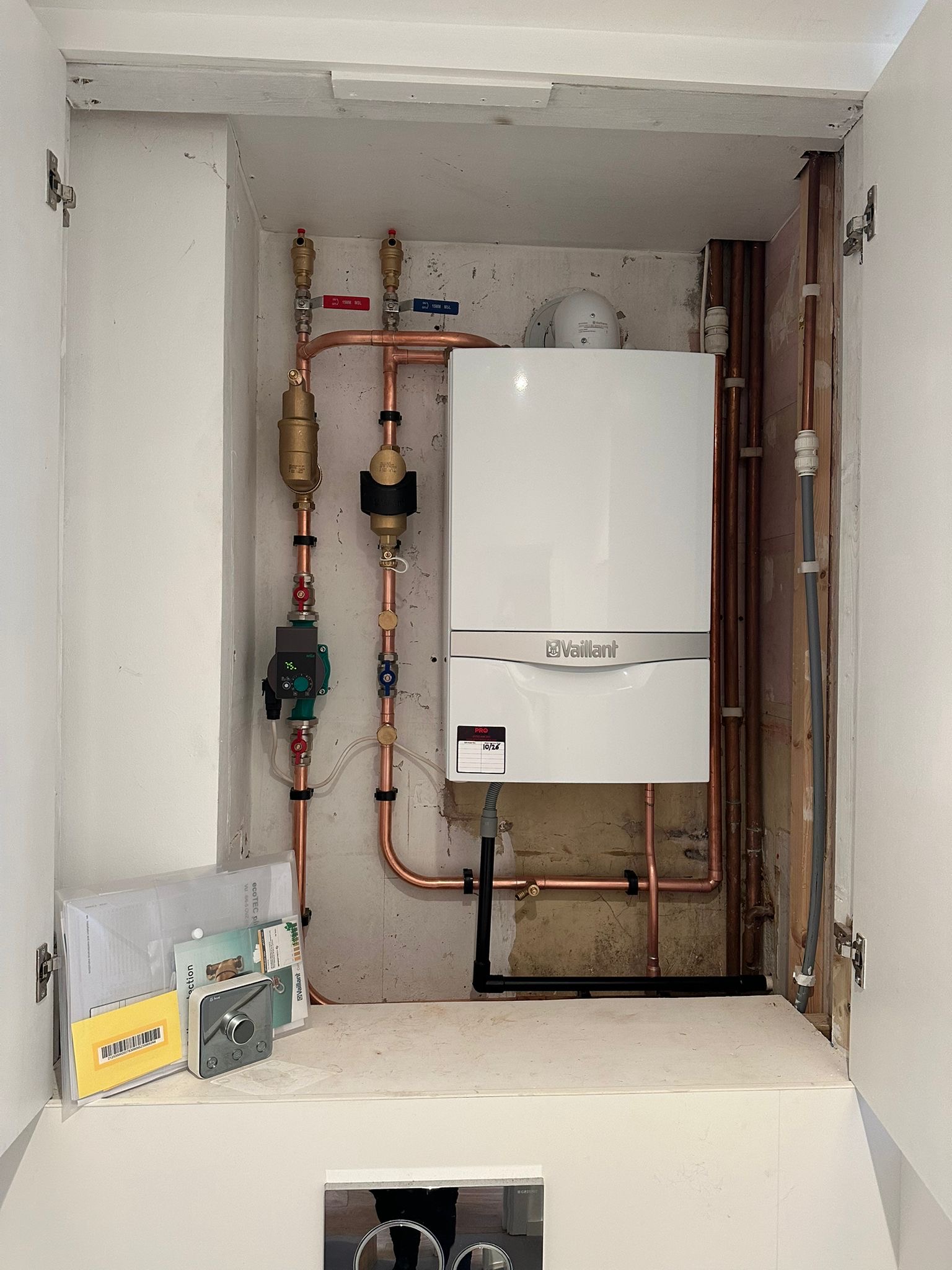
First, make it safe
Water near a boiler is never something to ignore, but most leaks give you time to act calmly. Before you start investigating, do these things:
- Turn the heating off at the controls so the system cools and stops circulating.
- Do not touch wet electrics, sockets, switches or wiring. If water is reaching anything electrical, keep clear and call for help.
- Catch the water with a bowl, tray or towels so it does not soak into the floor or ceiling below.
- Take a photo of where the water is and note the reading on the pressure gauge. Both help an engineer diagnose the fault.
- Do not remove the boiler casing. The parts inside include gas and electrical components, and only a qualified engineer should open it.
If there is a lot of water, water is near electrics, or you can smell gas, treat it as urgent. For a gas smell, leave the property, do not use switches, and call the National Gas Emergency line on 0800 111 999 first.
Find the drip: a locator by where you see water
Where the water appears tells you far more than how much there is. Work through the places below and stop at the one that matches.
A puddle directly under the boiler
Likely meaning: water dripping from inside the casing or from the connections on its underside. This can come from a failing internal seal, a pump, a heat exchanger or a valve. What you can do: catch the water, keep the heating off and watch the pressure gauge. If the pressure is falling, water is leaving the sealed system. Who fixes it: an engineer, through boiler repair. Do not try to tighten anything inside the boiler.
From the copper pipe that goes out through the wall
Likely meaning: this is usually the pressure relief discharge pipe. If it drips or runs, the system pressure may have risen too far, or the relief valve may be letting by. What you can do: check the gauge against the range marked on it and in your manual. Never tamper with the relief valve or block the pipe. Our post on a boiler losing pressure explains why the gauge then falls afterwards. Who fixes it: an engineer, as the cause is often the expansion vessel or the valve itself.
From the plastic condensate pipe or its outlet
Likely meaning: condensing boilers produce slightly acidic water, which runs away through a plastic pipe to a drain. A small amount of water at the drain end is normal. Water escaping from a joint along the pipe, or backing up near the boiler, is not. What you can do: in cold weather, the pipe may be frozen outside, which also makes the boiler stop. Our guide to a frozen condensate pipe walks through the safe thaw. Who fixes it: a split or poorly supported run needs an engineer.
From joints and pipes next to the boiler
Likely meaning: a weeping compression fitting, a valve or a filling loop connection. These often show as a bead of water or a green or white crust around a joint. What you can do: dry the pipes, then hold a dry tissue under each joint to find the wet one. If it is the filling loop, check its valves are fully closed. Who fixes it: a joint repair can be booked through plumbing repairs or as part of a boiler visit.
From something above, running down onto the boiler
Likely meaning: sometimes the boiler is not leaking at all. A radiator, a pipe in the floor above or a cylinder cupboard can drip down and collect on top of the casing. What you can do: dry the top of the boiler and look upwards. Check any radiator above for a wet valve, using our guide to a leaking radiator valve. Who fixes it: depends on the source, but water running onto a boiler should be stopped quickly.
Normal condensate or a fault?
People often worry when they see water at the end of the condensate pipe on a cold day. A modest trickle at the drain when the boiler is firing is how a condensing boiler works. Signs that something is wrong include water where the pipe should be dry, water pooling inside the room, gurgling from the boiler or the boiler stopping in freezing weather. If you see steam-like plumes from the flue, that is normally vapour, not a leak.
What happens to the pressure afterwards
Any leak from the heating side of a sealed system will lower the pressure. Once the leak has been found and fixed, the system may need topping up. Our step-by-step guide to repressurising a boiler covers the safe method. Do not keep refilling to cover an active leak; it hides the problem and brings fresh oxygen into the system, which encourages corrosion.
A leak can also trigger a fault code. Our boiler fault codes guide explains how to read the display without guessing, and if the leak has left you with no hot water, see boiler not heating water.
When to call, and what to tell us
Call straight away if the boiler is pouring water, water is reaching electrics, the boiler has stopped and will not restart, or you cannot find the source. A visit through boiler breakdown covers boilers that have stopped, and emergency plumbing is there for water that will not stay contained.
When you ring, it helps to tell us the make of boiler, where the water appears, the gauge reading and whether the heating and hot water still work. Your photos are useful too. Our Sevenoaks team is on 01732 444555, Monday to Friday 7am to 10pm and Saturday to Sunday 9am to 8pm, or use our contact page. We are Gas Safe registered, and our minimum charge is £90 + VAT, including the first hour on site.